
Kazakhstan and Germany Prepare New Projects in Industry, Energy and Critical Raw Materials
World
Kazakhstan President Kassym-Jomart Tokayev made an official visit to Germany, holding talks with Federal President Frank-Walter Steinmeier and Federal Chancellor Friedrich Merz. The discussions focused on trade and investment, industrial cooperation, critical raw materials, energy, transport, digitalisation, artificial intelligence and education.

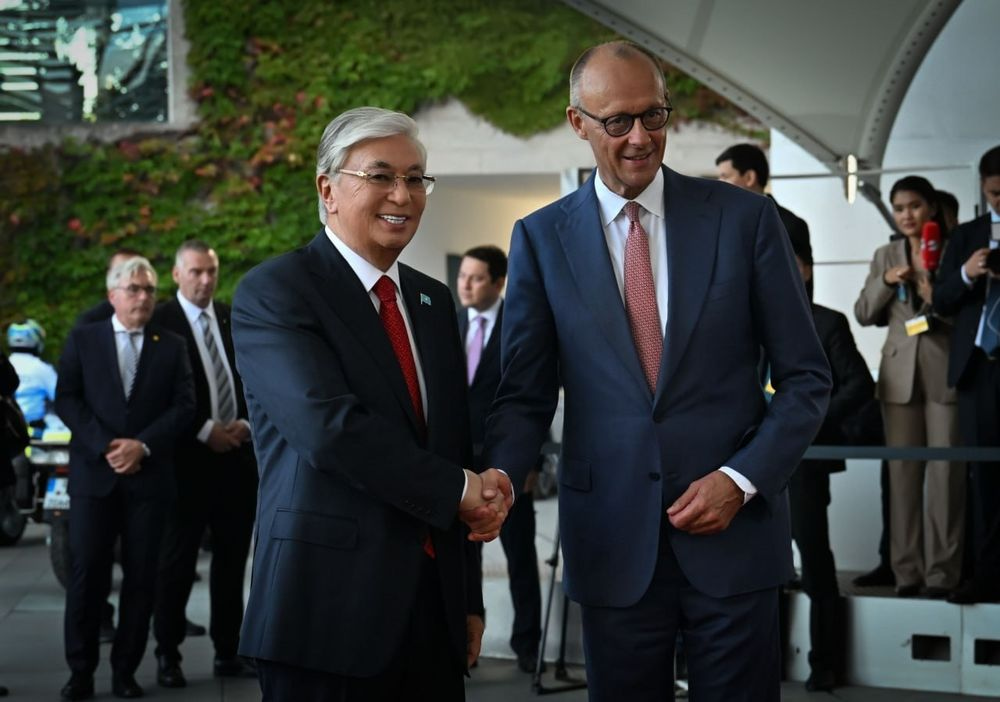
Tokayev described Germany as one of Kazakhstan’s key partners in Europe. Bilateral trade reached $4.5 billion in 2025 and exceeded $2.6 billion in the first seven months of 2026. More than 1,400 companies with German participation are registered in Kazakhstan, while cumulative German investment over 21 years has reached $8 billion. Companies active in Kazakhstan include CLAAS, Rhenus Logistics, Siemens Energy and Linde. The German government identifies Kazakhstan as Germany’s largest trading partner in Central Asia.
In Berlin, Tokayev proposed launching a Kazakhstan-Germany Investment and Industrial Initiative built around a single portfolio of flagship projects. He said the two countries should move from individual successful projects towards systematic industrial cooperation, bringing German technologies and expertise to Kazakhstan and producing higher-value goods. The joint investment portfolio includes 40 initiatives worth more than $54 billion, 21 of which have already been implemented.
Critical raw materials were another major area of discussion. Kazakhstan has 21 of the 34 raw materials classified by the European Union as strategic. Tokayev proposed developing full-cycle projects covering geological exploration and extraction through processing and production of higher-value materials.
Energy was also identified as a priority. Kazakhstan proposed creating a portfolio of joint projects to modernise its energy infrastructure and, where economically viable, move from importing equipment to manufacturing it domestically. Cooperation between Siemens Energy and Kazakhstan’s national electricity grid operator KEGOC was highlighted as an example of the potential for further cooperation.
Agriculture was another area discussed. According to Tokayev, bilateral trade in agricultural products increased by 23% in 2025, while Kazakhstan’s agricultural exports to Germany grew by 38%. He proposed joint projects covering the entire value chain, including precision agriculture, water-saving technologies, processing, storage and exports.
Kazakhstan has identified artificial intelligence and digital transformation as national priorities. The country is developing a “Data Centre Valley”, while German companies were invited to participate in data-centre infrastructure and develop AI-based solutions for mining, energy and logistics.
The two sides also agreed to expand cooperation in transport, including the Middle Corridor. Germany considers Kazakhstan an important partner in Central Asia, while Berlin and Astana intend to strengthen resilient logistics and energy links. A roadmap for industrial, technological and raw-materials cooperation for 2026–2028 has been agreed.
A Kazakhstan-Germany business forum was held during the visit. Tokayev said more than 30 commercial documents worth around $2 billion had been signed. Education and research were also discussed: 45 Kazakh universities cooperate with around 100 German partners, while about 2,000 Kazakh citizens study in Germany.
Tokayev proposed expanding dual-degree programmes, establishing a network of Kazakhstan-Germany industrial competence centres and developing joint research. Kazakhstan plans to increase spending on research to 1% of GDP and is seeking broader cooperation with German universities and companies in technology transfer.
During the visit, Tokayev also met with Steinmeier. The Kazakh President awarded the German Federal President the Order of Altyn Qyran, Kazakhstan’s highest state decoration, citing his contribution to bilateral relations. Steinmeier said Kazakhstan and its people were of great importance to him and expressed confidence that the two countries’ friendly relations would remain long-term and solid.
The presidents of Kazakhstan and Germany also adopted a joint declaration on further cooperation in the economy, energy, transport, digitalisation, artificial intelligence, education and environmental projects.
Powered by Froala Editor