


The Art and Culture Development Foundation Presented the Creative Industries Park
Uzbekistan
In Uzbekistan, creativity is officially shifting into a fully-fledged economic sector equipped with its own legal framework, sweeping tax incentives, and an expansive nationwide infrastructure. The Art and Culture Development Foundation (ACDF) has unveiled the Creative Industries Park — a unique state-led ecosystem designed to transform the local ideas of artists, designers, and filmmakers into highly competitive international exports. Residents are promised not just a relief from red tape, but direct integration into a nationwide network of hubs stretching from ultra-modern capital campuses to historic heritage art clusters in Samarkand and Bukhara.

On May 23, 2026, the Art and Culture Development Foundation of Uzbekistan introduced a major state initiative: the Creative Industries Park. Established by a Decree of the President, the Park is designed to unify disparate creative segments into a single, functional ecosystem, offering artists, designers, musicians, and entrepreneurs clear rules of engagement, tax preferences, and direct pathways to foreign markets.

The initiative encompasses 142 types of economic activities across 15 core disciplines, including fashion, architecture, media, cinema, IT, and museum studies. To attain resident status and access the preferential tax and legal regimes, applicants must demonstrate that at least 80% of their annual revenue is generated strictly within these creative domains. This threshold is specifically designed to filter out non-core businesses. Furthermore, residents will benefit from a streamlined digital registration platform engineered to eliminate bureaucratic friction.

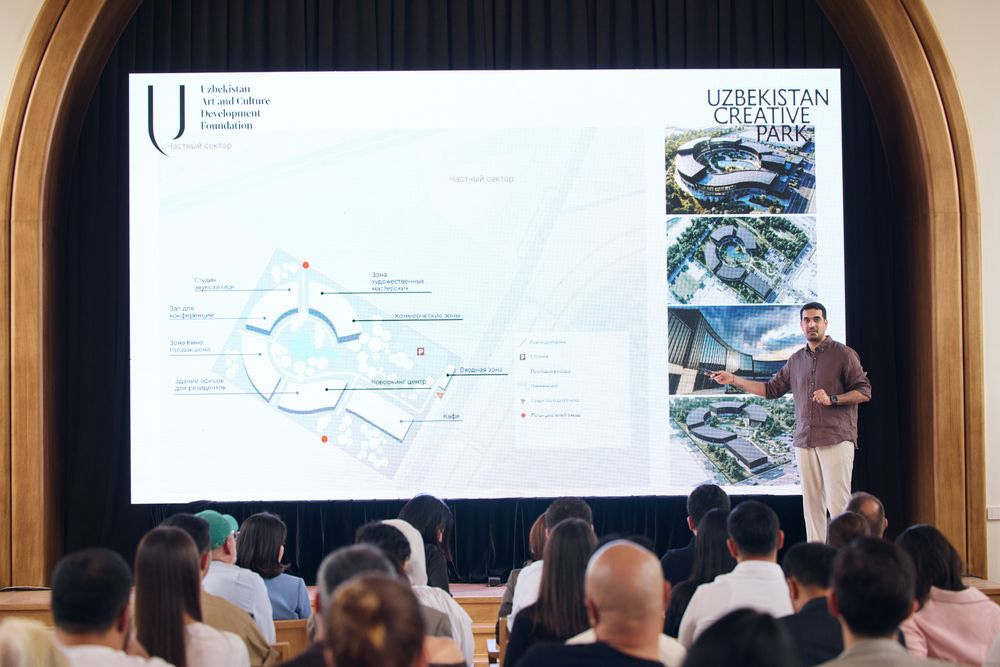
The physical backbone of the Park will feature a distributed national network of creative spaces. Tashkent will host a flagship hub on Farobiy Street complete with co-working zones and concert venues, alongside the "Yangi Toshkent" campus — a dedicated production environment housing sound recording and film studios. In Nukus, a reconstructed hangar will morph into the "Istiqlol" Park featuring a Children's Library, which will also house the deconstructed yurt from Milan Design Week and the national pavilion from EXPO 2025 Osaka. Creative clusters in Samarkand, Bukhara, and Khiva will be embedded directly within cultural heritage sites. As noted by the Park's Director, Hasan Salikhov, the primary objective is to empower local talents to realize their potential at home while engineering globally competitive products.

The presentation took place at ACDF's brand-new co-working facility. Currently at the vanguard of the nation's cultural diplomacy, ACDF has curated landmark exhibitions across 17 countries (including the Louvre and the British Museum) drawing over 5 million visitors, launched the inaugural Bukhara Biennial, and initiated the Tashkent Modernism architectural project. The Foundation is currently overseeing the restoration of the Center for Contemporary Art in Tashkent (opening September 2026) and the construction of the new National Museum designed by Tadao Ando.
The initiative encompasses 142 types of economic activities across 15 core disciplines, including fashion, architecture, media, cinema, IT, and museum studies. To attain resident status and access the preferential tax and legal regimes, applicants must demonstrate that at least 80% of their annual revenue is generated strictly within these creative domains. This threshold is specifically designed to filter out non-core businesses. Furthermore, residents will benefit from a streamlined digital registration platform engineered to eliminate bureaucratic friction.
The physical backbone of the Park will feature a distributed national network of creative spaces. Tashkent will host a flagship hub on Farobiy Street complete with co-working zones and concert venues, alongside the "Yangi Toshkent" campus — a dedicated production environment housing sound recording and film studios. In Nukus, a reconstructed hangar will morph into the "Istiqlol" Park featuring a Children's Library, which will also house the deconstructed yurt from Milan Design Week and the national pavilion from EXPO 2025 Osaka. Creative clusters in Samarkand, Bukhara, and Khiva will be embedded directly within cultural heritage sites. As noted by the Park's Director, Hasan Salikhov, the primary objective is to empower local talents to realize their potential at home while engineering globally competitive products.
The presentation took place at ACDF's brand-new co-working facility. Currently at the vanguard of the nation's cultural diplomacy, ACDF has curated landmark exhibitions across 17 countries (including the Louvre and the British Museum) drawing over 5 million visitors, launched the inaugural Bukhara Biennial, and initiated the Tashkent Modernism architectural project. The Foundation is currently overseeing the restoration of the Center for Contemporary Art in Tashkent (opening September 2026) and the construction of the new National Museum designed by Tadao Ando.
Powered by Froala Editor